Decoding Prop AMMs: What’s Actually Happening With Humidifi
An in-depth look at the rise of Proprietary AMMs on Solana, using Humidifi as a case study to explore how on-chain liquidity is shifting from passive formulas to vertically integrated trading engines.
If you’ve spent any time trading on Solana recently, you’ve probably noticed that some “AMMs” don’t behave like AMMs anymore. They don’t drift off market and wait for arbitrage to correct them. They don’t leak easy edge. They update quickly, feel tight, and seem strangely resilient to typical atomic strategies.
That’s because they’re not operating as passive liquidity pools. They’re operating as proprietary trading engines deployed on-chain.
This is what people are starting to call a “Prop AMM.”
At a high level, a Prop AMM abandons the core premise of traditional DeFi liquidity. There is no public LP capital forming the backbone of the pool. There is no fixed mathematical identity like x*y=k defining price. Instead, capital, pricing logic, and execution strategy are vertically integrated inside the program itself. The contract becomes an execution shell for a private trading system.
Humidifi is one of the clearest examples of this model on Solana.
From Curves to Engines
Traditional AMMs are formula-first systems. Whether constant product, concentrated liquidity, or bin-based designs like DLMM, the pricing behavior is constrained by a mathematical framework. Arbitrageurs enforce alignment with external markets. LPs provide capital. The system is mechanical and, importantly, transparent.
A Prop AMM flips that relationship.
There is no obligation to derive price from a curve. Instead, pricing can be driven by internal strategy. That strategy can be updated frequently. Capital is not pooled from the public but deployed directly by the operator. The result is something that looks like a pool from the outside but behaves more like a colocated trading system.
Solana makes this viable. Its throughput, deterministic execution model, and low instruction costs allow programs to update pricing logic at a frequency that would be impractical elsewhere. When you can cheaply and quickly mutate internal pricing state, you don’t need a rigid formula to define your market.
You can just track the market.
State Obfuscation Isn’t Cosmetic
One of Humidifi’s more interesting design choices is its use of XOR-based state encoding. Important values are not stored in clean, human-readable form. They’re obfuscated directly within the program logic.
This isn’t an aesthetic choice. It’s defensive.
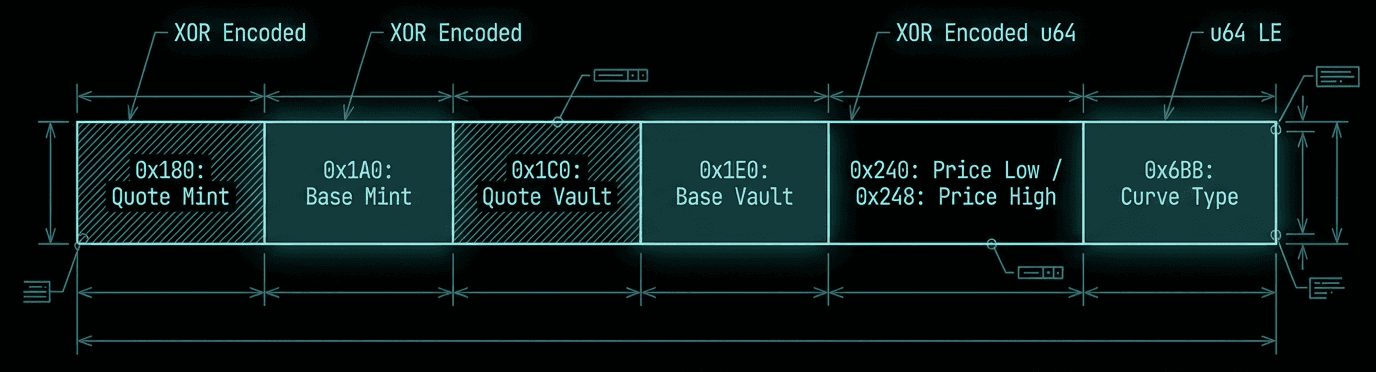
In a world where searchers, reverse engineers, and competitors constantly probe state to model strategy, transparency becomes a liability. Traditional AMMs lean into openness because their value proposition is neutrality. A Prop AMM doesn’t have that obligation. Its edge comes from its internal logic.
Obfuscation, in this context, is simply operational hygiene.
Precision as Infrastructure
Another notable detail is the use of a high-precision fixed-point math system, allocating 48 bits to the fractional component. On Solana, floating point arithmetic is not allowed, and naive integer math introduces rounding drift.
In low-frequency systems, rounding error is negligible. In high-frequency environments, especially those updating quotes constantly and processing small trades, that error accumulates. Over time, “dust” becomes measurable loss.
The math here isn’t flashy. It’s careful. That tells you what kind of system this is meant to be.
No Formula, Just Tables
The most structurally important difference is that Humidifi does not rely on a continuous pricing equation. Instead, it uses lookup tables that define discrete points on a pricing surface. When a trade comes in, the program determines the relevant interval and interpolates between predefined values.
This is fundamentally different from solving an invariant.
A formula imposes structure. A table allows arbitrary structure.
With lookup tables, you can reshape liquidity distribution without redeploying the contract. You can mimic stablecoin-like tight bands, introduce asymmetric depth, or adjust spreads dynamically. You are no longer constrained by the geometry of a curve.
You are defining a surface.
That flexibility is powerful, especially if you are attempting to mirror or track centralized exchange pricing behavior.
MEV Awareness by Design
Humidifi also incorporates execution-layer awareness. It inspects sibling instructions within the same transaction and can respond differently depending on context. That might include applying additional fees or modifying output if certain patterns are detected.
This is not a neutral liquidity pool passively responding to order flow. It is a system anticipating adversarial interaction.
On Solana, where atomic arbitrage and bundled execution are common, that awareness is not optional. If your liquidity is predictable, it will be harvested.
Prop AMMs attempt to reduce that predictability.
What This Signals
The emergence of Prop AMMs signals a shift in how on-chain liquidity is being deployed. Instead of public capital coordinated by simple formulas, we are seeing vertically integrated systems that combine capital, strategy, and execution logic inside the same contract.
From a trader’s perspective, this might simply look like tighter spreads or deeper liquidity. From a structural perspective, it represents the professionalization of on-chain market making.
These systems are not trying to be composable primitives. They are trying to be competitive trading entities.
And once that model proves viable, it’s hard to imagine it disappearing.